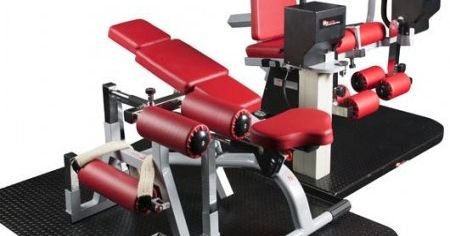
From Rehab to Performance: One System, Every Stage of the Athlete Journey
Most strength-and-conditioning setups force a choice: you train for rehab or you train for performance. Velocity Isokinetics was built around a different idea — that the same controlled, measurable resistance should carry an athlete from the physio bed all the way back to peak competition, on a single continuum of equipment.
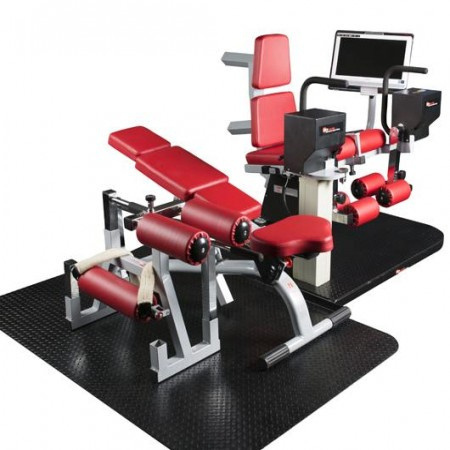
This is what isokinetic rehabilitation looks like in practice: not a separate phase bolted onto a performance program, but a controlled, data-driven continuum where the same resistance technology carries an athlete from the first post-injury session through testing and back to full competition output.
Here is how one isokinetic system serves every stage of the athlete journey — rehabilitation, testing and return-to-play, and high-speed performance.
One Technology, Two Worlds
The Velocity Isokinetics catalogue is deliberately split into two lines — Rehabilitation and Performance — but they share the same engineering: a double-acting hydraulic, pressure-regulated resistance and a Computer Managed Training System (CMTS) that records data on every rep.
That shared foundation is what makes the continuum possible. A machine that can rebuild tissue at low, controlled speeds can also develop explosive power at high speeds — because the underlying resistance adapts to the user, not the other way around.
Stage 1 — Rehabilitation: Controlled Speed, Low Joint Load
In early-stage isokinetic rehabilitation, the priorities are safety and control. Isokinetic resistance is accommodating — it matches the force the user applies, allowing resistance to be set at a constant speed through the full range of motion.
For post-injury work, that means:
- Lower joint compression than stacked-weight training — resistance comes from hydraulics rather than a fixed mass, which can make it well suited to early-stage rehab when appropriately programmed.
- Controlled speed — variable speed control lets a practitioner start slow and progress as tissue tolerance improves.
- Full-range movement — resistance holds through the entire arc of motion, not just where leverage is easiest.
Rebuilding tissue without re-injuring it
The Grand Velocity Machine is the flagship of the rehabilitation line — an all-in-one Isokinetic, Isometric and Isotonic unit built for rehabilitation professionals to test, monitor and treat. It is designed to support the rehabilitation and recovery of injured tissue, and to help rebuild strength and performance.
For portable, early-stage work on smaller joints, the compact Ankle Machine covers ankle (plantar/dorsi flexion, inversion/eversion) and wrist movements, with 10 load settings and variable speed control from 10 to 300 deg/sec.
Stage 2 — Test and Monitor: The Data That Drives Decisions
Between rehab and performance sits the most important — and most often skipped — phase: testing. Velocity Isokinetics equipment records strength, torque, endurance, power, range of motion and comparison data, and the Grand Velocity Machine displays 80 individual fields of data.
Ratios, imbalance and fatigue
This is where isokinetic testing earns its place. The Knee machine measures Quad-to-Hamstring ratios under fatigue and displays both limbs simultaneously, so imbalance is visible even at high speeds. The Grand Velocity Machine uses two motors to measure unilateral and bilateral function, and can simultaneously measure flexion and extension balance ratios.
Left-versus-right and agonist-versus-antagonist ratios are the numbers that flag a hidden deficit long before it becomes a re-injury.
Return-to-play testing
Return-to-play decisions are only as good as the data behind them. Instead of guessing when an athlete is “ready,” objective isokinetic testing gives clinicians a measurable benchmark:
- Is bilateral strength balanced? The Grand Velocity Machine measures both limbs simultaneously, so left-versus-right deficits are visible even at high speed.
- Has the Quad:Hamstring ratio normalised under fatigue? The Knee machine tracks this ratio through a fatiguing protocol, revealing whether the hamstrings can still protect the knee when it matters.
- Can the athlete produce power through the full range without compensation? Power output in watts, captured across the full arc of motion, shows whether the injured side is generating genuine effort or shifting load to the healthy limb.
Because the same equipment records data at every stage, a clinician can compare today’s test against the athlete’s pre-injury baseline or their last rehab session — turning “return to play testing” from a subjective call into a repeatable, evidence-based decision.
Stage 3 — Performance: Speed and Power
Once an athlete is cleared, the same machines that rebuilt them develop them. This is where high-speed isokinetic training separates from conventional methods.
The Knee machine offers variable speed control up to 800 deg/sec; the Hip (view machine) fires the nervous system in the running position at sport speed; the Ferocity Multi (view machine) develops pressing and upper-body power up to 500 deg/sec. It is Australian-made sports performance equipment engineered to translate rehab gains into competition-ready output. Users have reported increases in vertical leap of around 5–10 cm and 40-yard sprint reductions of 0.1–0.4 s over roughly six weeks of training — these are user-reported outcomes rather than independently validated results.
The Continuum in Practice
The strength of the Velocity Isokinetics range is that you don’t change systems as the athlete progresses — you change the speed, the load setting and the protocol.
- Rehab: Grand Velocity Machine · view machine; Ankle Machine · view machine
- Assessment for all ages and joints: Velocity Machine
- Performance: Hip · view machine; Knee · view machine; Ferocity Multi · view machine; Torso · view machine
The Velocity Machine is built as an isokinetic machine for all ages — compact (W: 0.7 m, L: 0.7 m), covering shoulder, chest, trunk, back, elbow, hip and knee across fitness, rehabilitation and athletic development reflex training, designed to minimise joint load.
Why It Works: PRS and Dual-Concentric Foundations
Two technologies underpin the whole continuum:
- Pressure Resistance System (PRS) — an advanced, accurate pressure-activated hydraulic system. PRS is designed to maintain accuracy as oil temperature rises, with the valve regulated by pressure rather than fluid viscosity.
- Dual-concentric loading — engaging opposing muscles continuously in both directions, balancing strength differentials across pairs like Quads/Hamstring, Glute/Hip-flexor and Chest/Shoulders.
Explore the science in Power = Force × Velocity, the engineering in The PRS Advantage, and how it compares to other resistance in Isokinetic vs Isotonic vs Pneumatic.
The Takeaway
Rehab and performance aren’t opposite ends of a spectrum — they are points on the same line. With controlled speed, objective testing data and high-speed power on one platform, Velocity Isokinetics lets a clinic and a high-performance program speak the same language.
Want to map the rehab-to-performance continuum for your athletes or clients? Browse the full equipment range to find the right machine mix for your facility — or ask Velocity Isokinetics about custom-built equipment and trained after-sales support.