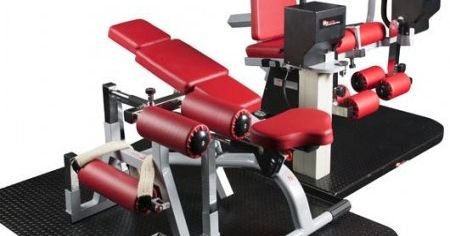
The PRS Advantage: Inside Our Patented Pressure Resistance System
When you train on a Velocity Isokinetics machine, the resistance you feel against every rep isn’t created by a stack of weights, an elastic band, or compressed air. It is generated by a hydraulically controlled, pressure-regulated valve at the heart of the system — the Pressure Resistance System (PRS).
PRS is the engineering core that sets Velocity Isokinetics apart from conventional strength equipment. It is the reason our machines can run at the high speeds needed for real power output while still delivering accurate, repeatable measurements. In this article we unpack what PRS is, how the double-acting hydraulics work, and why it should not be confused with air-based systems.
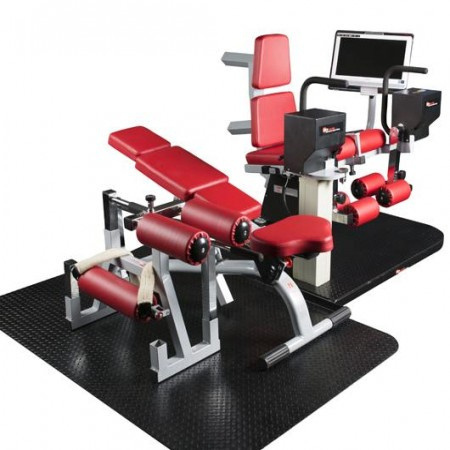
What Is the Pressure Resistance System (PRS)?
The Pressure Resistance System is Velocity Isokinetics’ pressure-activated control valve. Rather than resisting movement with a fixed mass (like a weight stack) or a compressed gas (like a pneumatic cylinder), PRS regulates resistance by metering hydraulic fluid through a precisely controlled valve.
The result is accommodative, isokinetic resistance — load that matches the user’s effort throughout the entire range of motion. Push harder and the system holds the set speed; ease off and the resistance backs off with you. That continuous matching is what makes high-speed training well suited to rehabilitation and intense enough for elite performance.
Double-Acting Hydraulics, Explained Simply
PRS runs on double-acting hydraulic resistance. “Double-acting” simply means the system resists movement in both directions of a rep — the push and the pull, the up and the down.
This is the foundation of Velocity Isokinetics’ dual concentric training approach. On a reciprocating movement, opposing muscle groups (think quads and hamstrings, or glutes and hip flexors) both work against resistance as the limb travels each way. There is no “free” return stroke. The nervous system is engaged continuously, which is central to how the platform trains speed and power rather than strength alone.
Founder Alan Maynard first explored this idea decades ago with his double-acting hydraulic circuit training equipment, and PRS is the modern, high-speed evolution of that concept.
PRS Is Not Pneumatic: Hydraulic Resistance vs Air Systems
One of the most common misunderstandings about Velocity Isokinetics equipment is the assumption that, because the movement is smooth and fluid, it must be “air” or pneumatic resistance. It is not.
Hydraulic fluid (oil) is effectively incompressible. When PRS meters oil through its valve, the resistance responds instantly and predictably to the force you apply. Compressed air, by contrast, is a gas — it compresses and expands, which introduces a softer, “spongy” feel and a slight lag between effort and resistance.
For high-speed isokinetic work, that difference matters. A system that has to compress gas first cannot hold a constant, accurate speed as precisely as a pressure-regulated oil valve. PRS is a double-acting hydraulic, pressure-regulated system — and, as the catalogue states, it is not to be confused with air or pneumatic systems.
For a broader comparison of how isokinetic resistance stacks up against isotonic and pneumatic options, see our guide to isokinetic vs isotonic vs pneumatic training.
Temperature-Stable Accuracy: Why PRS Is Designed to Hold Its Numbers
Every hydraulic system faces the same engineering problem: as fluid warms up during a session, it thins out. In a conventional hydraulic setup, that thinning shifts the resistance curve — the numbers drift, and what read accurately at the start of a workout feels different half an hour later.
PRS is designed to address exactly this. According to the catalogue, the pressure-activated hydraulic system is designed to maintain accuracy as oil warms — the valve is regulated by pressure rather than by the viscosity of the fluid, the aim being that the readings stay consistent from the first rep to the last.
This is the point we make when we explain “Why Grand?” on the Grand Velocity Machine. For a clinical testing and rehabilitation system that reports up to 80 individual fields of data across a speed range of 2 to 600 degrees per second, accuracy that holds up as the oil warms is not a nice-to-have — it is the whole premise of the data.
Where You’ll Find PRS in the Range
PRS isn’t confined to one machine — it underpins the hydraulic resistance system across the Velocity Isokinetics range. Two machines where the pressure-activated system is called out explicitly:
- Grand Velocity Machine — the flagship clinical system, an all-in-one isokinetic, isometric and isotonic unit with two motors for unilateral and bilateral testing. The “Why Grand?” notes specifically highlight its pressure-activated hydraulic system, designed to hold accuracy as the oil warms.
- Knee machine — the high-speed isokinetic knee machine, whose advanced hydraulic system uses the pressure-activated valve for increased accuracy while measuring quad-to-hamstring ratios under fatigue.
Both lean on the same principle: accurate, repeatable resistance that holds steady whether you are testing a rehab patient at low speed or an athlete at high speed.
Why PRS Matters for Power and Rehab
Because PRS holds a constant speed under varying effort, it does two things that conventional resistance struggles to deliver at the same time:
- It is well suited to rehabilitation. Because PRS accommodates to the user’s effort and can be run in a concentric-concentric mode with no eccentric phase and no fixed mass, it is well suited to rehabilitation and low-impact conditioning.
- It allows true speed. Because resistance matches effort rather than capping it, athletes can move at competition-like speeds against real load.
That combination — accommodating and fast — is what the entire Velocity Isokinetics platform is built around. To see how PRS feeds into measured power output, read Power = Force × Velocity: why we measure watts, not just reps.
The Patent Behind PRS
PRS is associated with Australian Innovation Patent No. 2020101146, listed among the company’s credentials alongside its 100% Australian design and manufacture, and it is part of founder Alan Maynard’s long history of development in resistance equipment engineering.
Talk to Velocity Isokinetics
PRS is the difference between a machine that simply resists movement and one that measures, adapts, and holds its accuracy rep after rep. If you would like to understand how the Pressure Resistance System applies to your facility — for athletic performance, rehabilitation, or research — get in touch with Velocity Isokinetics through our contact page to enquire or arrange a demonstration.